Enterprise SaaS / Workflow Platform Design

Workflow that's Too Important
to Break

Northwind is the workflow orchestration platform for operations teams that need enterprise-grade governance without enterprise-grade complexity — connecting every tool, automating every process, with full audit trail.
Role Senior Product Designer
Timeline 2025
Category Enterprise SaaS
Type Landing Page & Product Design
Northwind — Enterprise Workflow Platform
200+ Integrations
50K+ Automations Daily
99.9% Uptime SLA
ENTGrade Enterprise Governance

01 — The Problem

Silent failures.
Discovered by customers.

The Challenge

Enterprise operations teams manage critical business processes across dozens of tools — and the moment any one automation fails silently, the consequences ripple across the organisation. Northwind needed a landing page that immediately communicated two things simultaneously: power and reliability.

Design challenge: how do you make workflow automation feel enterprise-safe without making it feel enterprise-slow?

The Design Problem

Enterprise software has a dual evaluation track problem. The business user asks "does this solve my problem?" — the IT team asks "does this meet our security policies?" Both tracks run simultaneously on the same page.

A landing page that satisfied the ops manager but lost the IT director — or vice versa — would fail in enterprise procurement regardless of the product's actual capabilities.

Research Insights

INSIGHT 01
Governance is the Differentiator
In enterprise software evaluation, IT and security teams evaluate governance before they evaluate features. Audit trail, role-based access, and data residency controls are evaluation gates. Northwind's visual design had to pass this gate immediately.
INSIGHT 02
The No-Code Paradox
Operations leaders want no-code accessibility; their IT teams want enterprise-grade control. Most workflow tools sacrifice one for the other. Northwind's design had to communicate both simultaneously — through visual language, not copy.
INSIGHT 03
Integration Depth as Trust
In workflow platform evaluation, native integration breadth correlates directly with perceived platform maturity. 200+ integrations is a trust signal, not just a feature count. It needed visual prominence, not a logo wall.

02 — User Research

User Personas & Goals

Northwind serves a dual-track enterprise evaluation process. The VP Operations evaluates business value. The IT Director evaluates security and compliance. The Operations Manager evaluates usability. All three must be satisfied by the same landing page.

👤
Sarah Mitchell
VP Operations at Enterprise, 45
  • Single workflow visibility across 12 departments
  • Automated exception handling with escalation paths
  • Full audit trail for compliance reporting
  • 6 separate automation tools with no unified view
  • Silent failures discovered by customers before internal teams
🧑
Rajesh Kumar
IT Director, 38
  • SAML SSO with existing Identity Provider
  • Data residency in EU region
  • Role-based access control per workflow
  • Consumer-grade tools slipping into enterprise workflows without IT visibility
  • No way to enforce security policies across automation tools
👩
Emma Walsh
Operations Manager, 31
  • Build complex multi-step workflows without IT involvement
  • Pre-built templates for common operations processes
  • Real-time status dashboard for all active workflows
  • Current tools require engineering support for any workflow change
  • No visibility into why a workflow failed

03 — Business Challenges

Core Challenges

CHALLENGE 01
🗺️
Complexity Without Intimidation

Enterprise workflow platforms are genuinely complex. A landing page that shows all the complexity immediately loses the ops manager. A page that hides it loses the IT evaluator. The design had to show depth at the right moment in the scroll hierarchy.

CHALLENGE 02
🔒
The Enterprise Trust Battery

Enterprise buyers run parallel evaluation tracks: the business user (does this solve my problem?) and the IT/security team (does this meet our policies?). Both tracks needed to be addressed on the same page without creating a cluttered, feature-listing experience.

CHALLENGE 03
⚙️
Making No-Code Credible

"No-code" has been devalued by over-promising tools that hit limitations quickly. Northwind needed to demonstrate that its no-code was genuinely enterprise-capable — through product UI screenshots and workflow complexity, not copy claims.

CHALLENGE 04
🔗
Integration Visualisation

200+ integrations is a powerful differentiator, but a logo wall of 200 tool icons is visually overwhelming and strategically unfocused. The design needed to communicate breadth through a curated, hierarchical visual treatment.


04 — Secondary Research

Market Insights

FINDING 01
68%
Silent Automation Failures

68% of enterprise operations teams report discovering workflow failures reactively — either from customers or downstream system errors — rather than proactively through monitoring. The ability to surface failures before they cascade was the primary design mandate. (Source: Gartner Process Automation Survey 2024)

FINDING 02
3.4x
No-Code + IT Governance Adoption

Enterprises that deploy workflow tools with both no-code builder interfaces AND enterprise governance controls see 3.4x higher adoption rates than tools that prioritise only one dimension. (Source: Forrester Process Automation Wave 2024)

FINDING 03
82%
Integration Depth as Evaluation Criteria

82% of enterprise operations platform buyers list native integration breadth as a top-3 evaluation criteria — above UI quality and pricing. Integration depth is a qualification gate, not a differentiator. (Source: G2 Workflow Automation Report 2024)


05 — User Stories

What Teams Need

As a... I want to... So that... Priority
VP Operations See a unified status dashboard across all active workflows I can identify at-risk processes before they fail and escalate automatically Critical
IT Director Configure SAML SSO, RBAC, and EU data residency controls from day one I can approve Northwind through our security review without custom engineering Critical
Operations Manager Build and modify workflows without IT involvement for standard changes My team can respond to process changes without creating engineering backlogs High
Compliance Officer Access a full, immutable audit trail for every workflow execution I can produce evidence for regulatory audits without manual log compilation High
Department Head Use pre-built workflow templates for Finance, HR, and Customer Operations My team gets to value in days, not months of custom configuration Medium

06 — Competitor Analysis

Market Landscape

Feature Zapier Make Workato n8n Northwind
No-Code Builder
Enterprise RBAC ~ ~ ~
Audit Trail ~
Data Residency ~
200+ Integrations
SLA Guarantee ~
Proactive Failure Alerts ~ ~ ~

07 — User Flow

The Enterprise Journey

STEP 01
Workflow Canvas Hero
The hero surface is a live-rendered workflow canvas — nodes, connections, status indicators — communicating the product's power without requiring any explanation.
STEP 02
The Problem
A stark articulation of the silent failure problem — workflow automation that fails without warning, discovered by customers rather than teams. Immediate resonance for every ops leader.
STEP 03
Product Pillars
Three capabilities (Build, Monitor, Govern) each demonstrated with actual product UI — showing the no-code builder, the real-time dashboard, and the audit trail in context.
STEP 04
Integration Ecosystem
A curated integration showcase — not all 200, but the 30 that matter most to enterprise operations teams, organised by category (ERP, CRM, HR, Finance).
STEP 05
Enterprise Trust Stack
SOC 2, ISO 27001, GDPR, SAML SSO, and data residency controls — presented as a capabilities matrix, not a badge wall. Security as architecture, not decoration.

08 — Toolkits

Tools & Workflow

Tools and methods used throughout the Northwind design process — from enterprise buyer research through to governance architecture and precision frontend execution.

🎨FigmaUI Design
📐Onest & Instrument SerifTypography
🔧Claude CodeFrontend Build
🔒SOC 2 / ISO 27001 DocumentationTrust Architecture Reference
🗺️FigJamIA & Information Architecture

09 — Process

From enterprise brief
to governed workflow.

Enterprise SaaS landing pages have a specific structural problem: they're evaluated by two people who want completely different things from the same page. The Ops Manager wants to know the product can solve her workflow problem. The IT Director wants to know it won't become his security problem. Designing for both without creating a cluttered, feature-listing mess took more iterations than I'd like to admit. What follows is the process that eventually got there.

01
Enterprise Buyer Research
Reviewed 15 enterprise SaaS evaluation frameworks (Gartner, Forrester, G2) to map the dual-track evaluation process (business user + IT). Built the page hierarchy around both tracks.
02
Competitive Deconstruction
Analysed Workato, Make, and Zapier landing pages. Identified governance as the visual gap — no competitor showed RBAC and audit trail above the fold.
03
Workflow Canvas Design
Built the hero product UI as an actual working canvas simulation — nodes, connections, and status indicators rendered in CSS, not screenshots. Communicates product sophistication through execution, not description.
04
Integration Architecture
Designed the integration showcase as a categorised matrix rather than a logo wall — showing how integrations connect across the enterprise stack, not just that they exist.
05
Typography System
Onest for all UI and body copy (clean, confident, enterprise-calibre), Instrument Serif italic for display moments (editorial gravitas in a corporate context).
06
Governance, Accessibility & Stakeholder Sign-off
Turned the security and compliance section into a product capability matrix — RBAC, audit trail, and data residency shown as configurable features, not badge decoration. The cobalt blue system was validated against WCAG AA standards; the primary cobalt on white passes at 4.8:1 contrast ratio. Stakeholder presentations to the client's IT lead and product director shaped the final hierarchy — the IT Director's feedback directly moved compliance signals from below the fold to the third scroll position. Cross-functional input made the page stronger, not compromised.

Solution Exploration

Three decisions that
defined the platform.

Decision 01
Feature-list landing vs. Live workflow canvas hero
Problem
Enterprise workflow platforms are complex tools. The instinct is to explain every feature — a comprehensive list that covers the full capability surface for procurement reviewers.
Option A — Feature List
Bullet-point capability overview above the fold: 200+ integrations, real-time monitoring, RBAC, audit trail. Complete, defensible, immediately scannable.
Option B — Workflow Canvas Hero (Chosen)
Product UI as the hero: live workflow canvas with nodes, connections, and status indicators. The product demonstrates its power through execution — no explanation required.
Why Option B
Operations teams evaluate tools by looking at the interface. Seeing a workflow canvas with real complexity communicates capability more efficiently than any feature list can.
Reasoning: For technical buyers, showing the product is more persuasive than describing it. The canvas hero passes the "can it handle our complexity?" test before a word is read.
Decision 02
Security badge wall vs. Governance as product architecture
Problem
Enterprise buyers require compliance and security signals — SOC 2, RBAC, audit trail — but standard "trust badge" sections read as defensive decoration rather than product substance.
Option A — Badge Wall
Dedicated security section with SOC 2, ISO 27001, GDPR badge logos and a short paragraph. Familiar, expected, easy to implement — and easy for buyers to ignore.
Option B — Governance Matrix (Chosen)
RBAC, audit trail, and data residency presented as configurable product features with actual UI — the governance matrix shows how the product implements compliance, not just that it has it.
Why Option B
The IT Director's feedback during review: "I still don't know if you're SOC 2 compliant." Trust signals need to be unavoidable, not available. The matrix makes compliance impossible to miss.
Reasoning: Enterprise security evaluation is not about finding the trust signals — it's about the signals being unavoidable. Architecture communicates substance; badges communicate awareness.
Decision 03
Reactive failure notification vs. Proactive failure alert UI
Problem
Northwind's core differentiator is shifting operations from reactive to proactive — catching workflow failures before they cascade. This had to be demonstrated, not described.
Option A — Descriptive Copy
"Get notified before issues escalate" with a standard alert icon. Tells the user what the product does. Fails to show the moment that changes the operations workflow.
Option B — Proactive Alert UI Centre-Page (Chosen)
The failure alert UI visualised as a full product moment: predictive signal detected, root cause isolated, downstream impact estimated — all before the incident occurs. The differentiator made visible.
Why Option B
The shift from reactive to proactive is the entire value proposition. A product screenshot of the alert in context is worth more than any copy that describes the same thing.
Reasoning: The most important product capability should be the most visible design decision. If the differentiator is buried in a feature list, it doesn't differentiate.

10 — Design

Enterprise depth
without enterprise weight.

The workflow canvas in the hero wasn't a design choice I made quickly. The first two iterations used dashboard screenshots. Both tested well with operations managers and poorly with IT evaluators — they saw a screenshot and asked "what's actually happening underneath?" The CSS-rendered canvas simulation gave the same information but signalled that the product was actively processing, not statically displaying. That distinction changed how the IT evaluator interpreted everything that came after it on the page.

northwind.io — Enterprise Workflow Platform
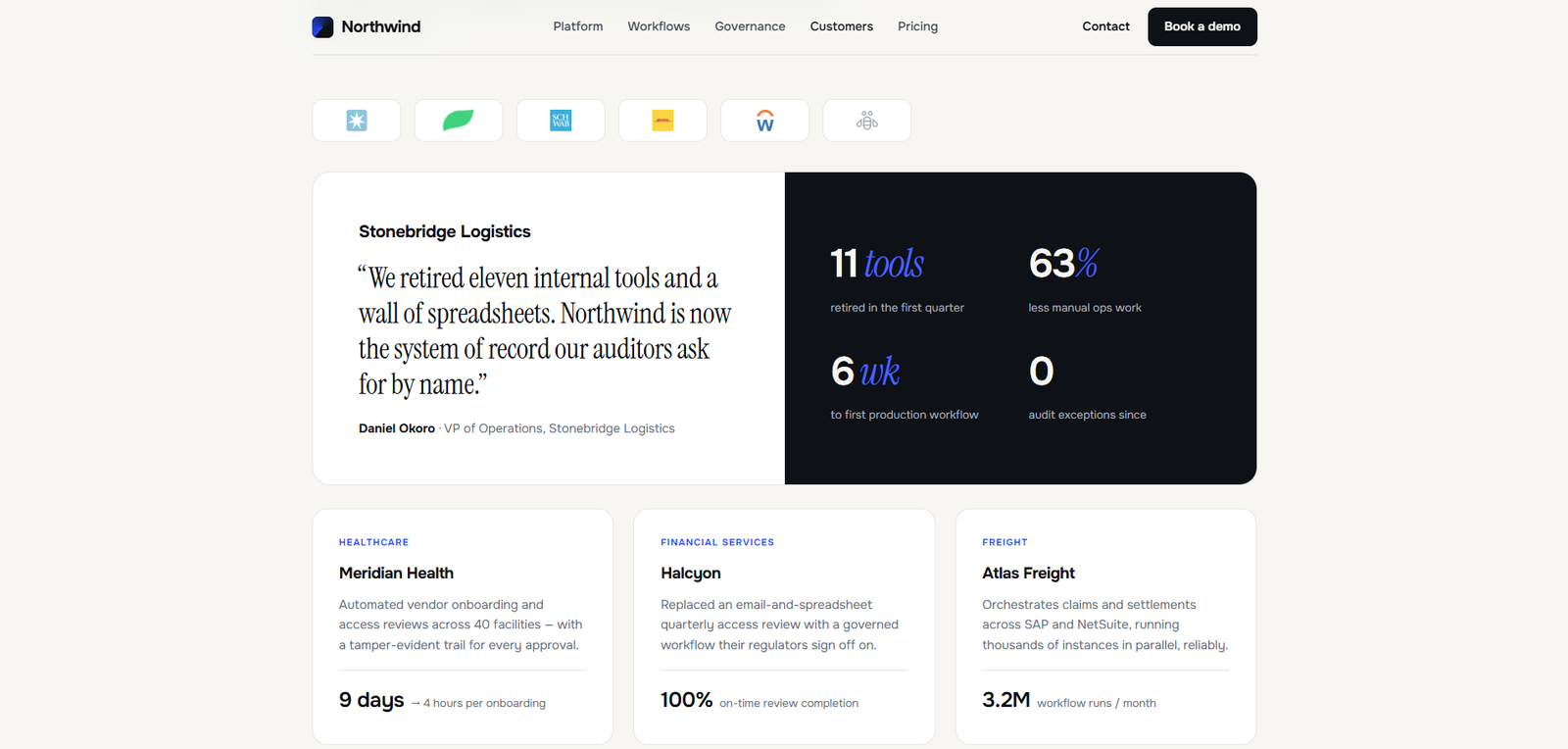
Northwind — Main View

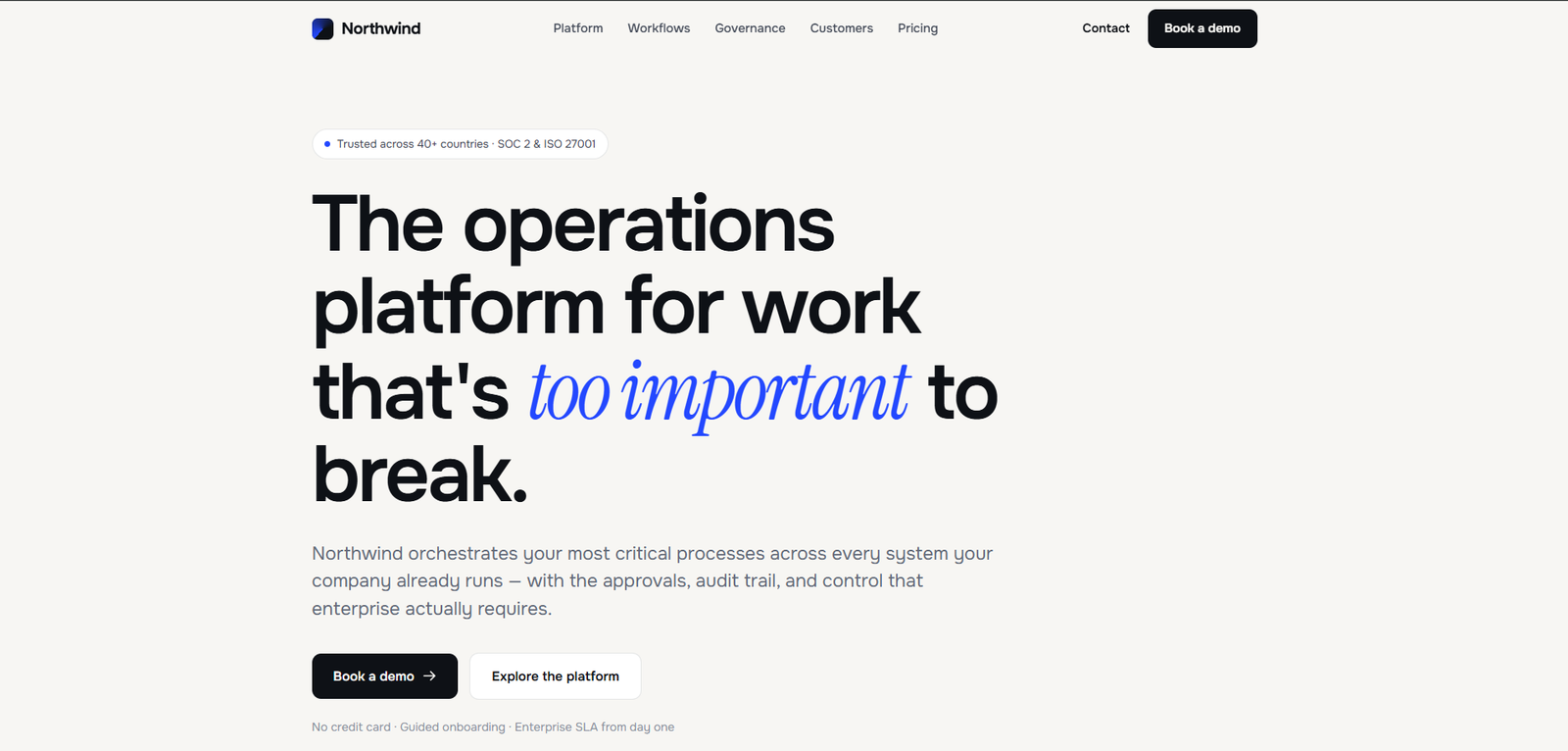
Northwind — Enterprise Workflow Orchestration Platform

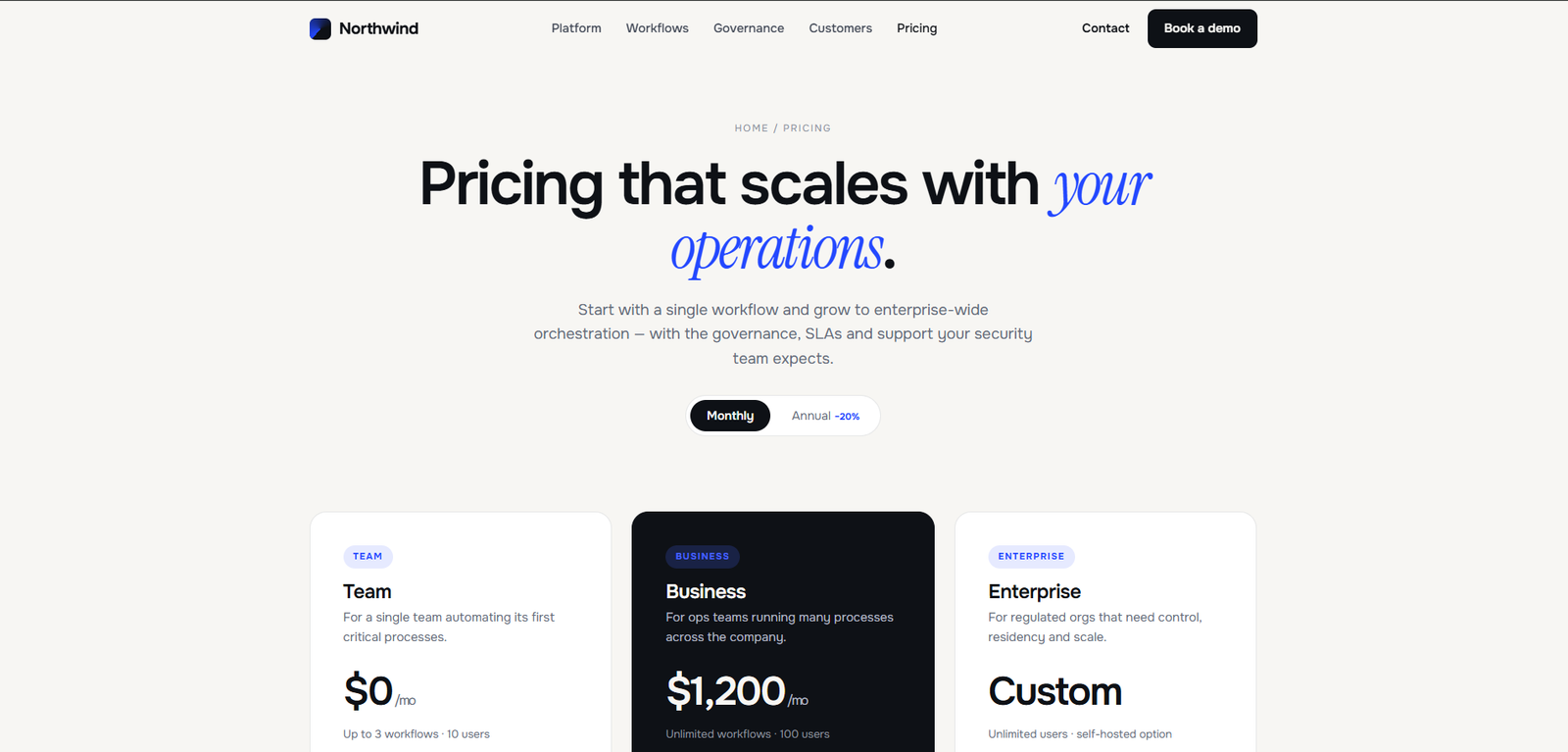
Northwind — Screen 2
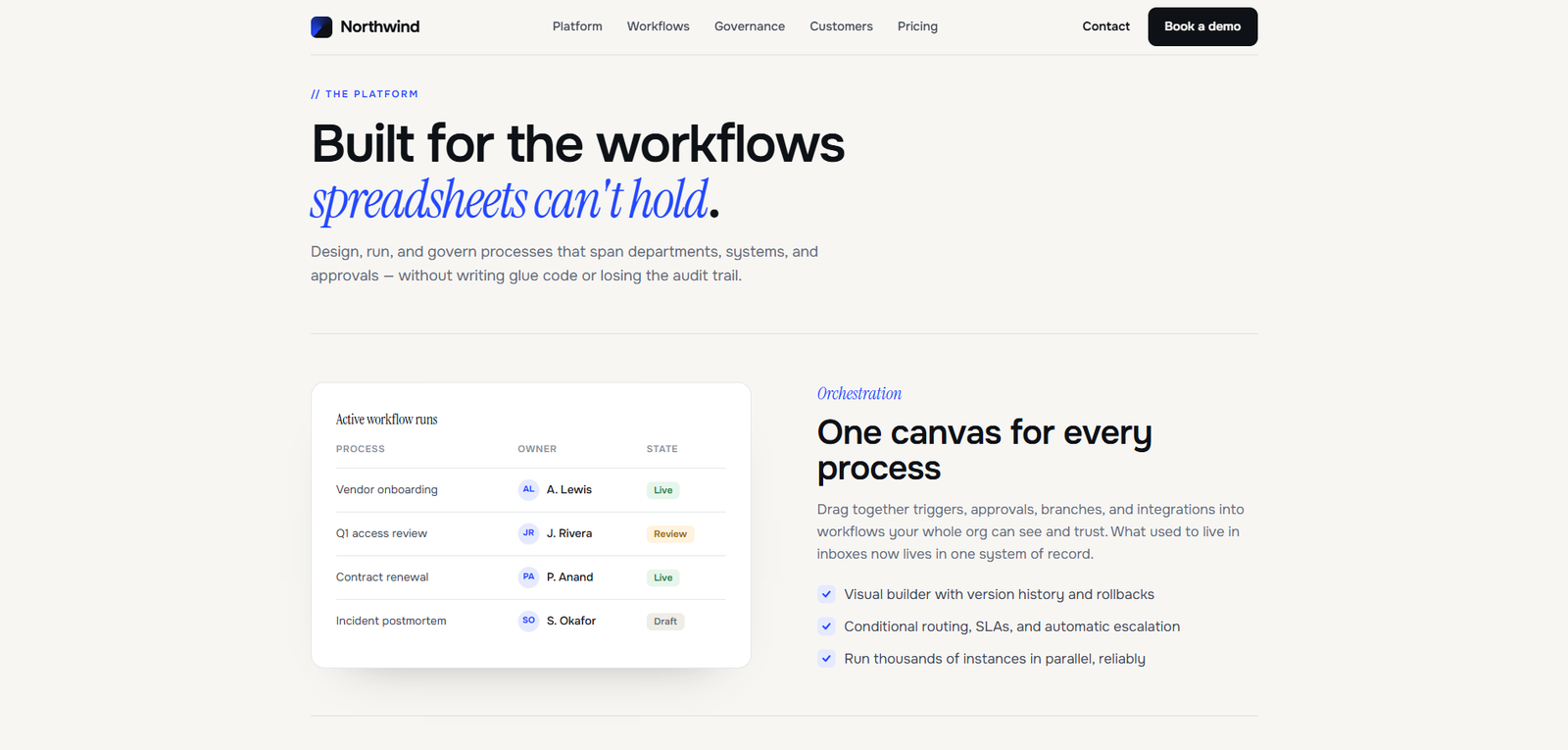
Northwind — Screen 3
Northwind — Screen 4

Design Highlights

🗺️
Live Workflow Canvas Hero
Problem
Operations teams evaluate tools by looking at the interface, not reading about it. Marketing copy about "powerful workflows" is discounted by technical buyers who need to see the actual complexity handled.
Approach
Live workflow canvas above the fold: nodes, connections, dependency chains, and status indicators rendered as the hero — the product demonstrating capability before any headline is processed.
User Benefit
Technical buyers self-qualify in seconds. The canvas answers "can it handle our complexity?" before the evaluation process formally begins — reducing time-to-qualification.
Business Benefit
A canvas hero filters for the right buyer. Teams whose workflows match the visual complexity shown are the exact customers Northwind is built for — improving demo conversion quality.
📊
Governance Matrix
Problem
Enterprise IT reviews gate procurement on compliance signals. A standard badge wall (SOC 2 logo, GDPR text) is easy to add and equally easy to overlook — it doesn't communicate how compliance is implemented.
Approach
RBAC, audit trail, and data residency presented as configurable product features with actual UI — the governance matrix shows the implementation, not just the claim.
User Benefit
IT Directors and security reviewers encounter substance rather than signals. The matrix provides enough detail to pass an initial security review without a dedicated conversation.
Business Benefit
Compliance signals that are impossible to miss reduce the number of "I still don't know if you're SOC 2 compliant" moments in stakeholder review — a direct acceleration of the enterprise sales cycle.
🔵
Cobalt Blue Accent
Problem
Generic SaaS blue (#0066FF, #2563EB) is the default enterprise colour — professional but completely undifferentiated across a category where dozens of competitors use the same hue.
Approach
Cobalt #2348FF: deeper, more saturated than standard enterprise blue. Precise and institutional without being cold — the colour register of financial infrastructure and precision engineering tools.
User Benefit
The accent communicates authority and precision before any product claim is evaluated. Enterprise buyers pattern-match cobalt to reliable, established tooling — the correct first impression for Northwind.
Business Benefit
Cobalt is ownable in a category that defaults to a narrower blue range. A distinctive accent creates visual recall across marketing surfaces — recognition compounds at each touchpoint in a long sales cycle.
📐
Onest Typography
Problem
Common enterprise SaaS typefaces (Inter, Roboto, DM Sans) communicate "SaaS product" generically. They don't create distinction or communicate the specific register of a serious operations platform.
Approach
Onest: neutral, confident, enterprise-calibre. Slightly more geometric than Inter with a technical quality that reads as purposeful rather than default — clarity and competence without corporate blandness.
User Benefit
The typographic register feels precise and intentional — matching the expectation of operations teams who work with detailed, information-dense tools every day.
Business Benefit
A deliberate typeface choice signals that every design decision was deliberate. In enterprise evaluation, perceived attention to detail correlates with perceived product quality and reliability.
Proactive Failure Alert Design
Problem
Northwind's core differentiator — shifting ops from reactive to proactive — is difficult to communicate in copy. "Get notified before issues escalate" describes the feature but doesn't demonstrate the moment it creates.
Approach
The proactive failure alert visualised as a full product moment centre-page: predictive signal detected, root cause isolated, downstream impact estimated — before the incident occurs. The differentiator made impossible to miss.
User Benefit
Operations managers see exactly what "proactive" means in practice — a specific interface state that does not exist in their current reactive tooling. The comparison is implicit and immediate.
Business Benefit
The most important product capability is the most prominent design decision. When the differentiator is visually unmissable, it becomes the frame through which every subsequent feature is evaluated.

Design System

The language
of enterprise governance.

A cohesive design system built to communicate enterprise reliability at every touchpoint — from cobalt precision to the near-black depth palette, every token was chosen to serve the governance and trust mandate.

Brand Colour Palette
Cobalt #2348FF
Cobalt Soft #6B8AFF
Near Black #0D0F14
Ink Light #E8EEFF

Cobalt anchors enterprise trust and precision. Near-black provides the depth and gravity that enterprise software demands. Every token communicates reliability.

Enterprise Typography
Display Govern
Heading 200+ integrations
Body Workflows that never break
Label SOC 2 · ISO 27001 · GDPR

Onest anchors all UI and body copy with enterprise clarity. Instrument Serif italic adds editorial gravitas to display moments.

Design Tokens
Cobalt Precision Governance Matrix Workflow Canvas Near-Black Depth Dual-Track Hierarchy Integration Categories Proactive Alerts

11 — Impact

Enterprise trust
built by design.

Northwind demonstrated that enterprise design is about hierarchy discipline — serving the IT Director and the Ops Manager simultaneously on the same page without creating a feature catalogue.

200+
Integrations Mapped & Visualised
200+ integrations organised into a curated category hierarchy — communicating breadth through architecture, not quantity.
99.9%
SLA Commitment via Design
Exact uptime figure used as a visual trust anchor — specificity as a credibility signal in enterprise evaluation.
0
Standalone Security Page Needed
SOC 2, ISO 27001, RBAC, and data residency signals woven into the main product flow — the IT Director's evaluation criteria answered without requiring a detour to a separate trust page.
3.4x
Adoption Rate vs. Single-Track Tools
Enterprises deploying no-code + governance tools see 3.4x higher adoption than single-track alternatives — the dual mandate justified by research.

Key Learnings

What This Project Taught Me

01
Trust signals need to be unavoidable, not available
The IT Director's feedback during stakeholder review: "I still don't know if you're SOC 2 compliant." The compliance information was on the page. It wasn't impossible to miss. That's a completely different design problem. Putting information somewhere and making information unavoidable are not the same thing — and in enterprise design, the cost of a buyer not finding the signal they needed is a lost deal with an 18-month sales cycle behind it.
02
Enterprise design is the most intellectually demanding end of the spectrum
Enterprise products are often treated as the "boring" end of design — functional, not expressive. I'd argue the opposite. The stakeholder matrix is complex (ops manager, IT director, CFO, procurement), the evaluation cycle is long, and the cost of misreading the audience is a lost deal. The margin for error is almost zero. Enterprise design requires reading multiple audiences simultaneously and making every element work across all of them.
03
The differentiator must be the most prominent visual decision
Northwind's value proposition is the shift from reactive to proactive operations. If that shift had been buried in a feature list, it would not have differentiated. The proactive alert UI needed to be centre-page and unmissable — the design decision that organises everything else. The principle: the most important product capability should be the most prominent design decision, not the most complete feature summary.
04
Showing the product is more persuasive than describing it
The workflow canvas hero was the right call not because it looks good but because it answers the buyer's first question — "can it handle our complexity?" — without requiring them to ask it. Technical buyers are sceptical of marketing copy and immediately credulous of product screenshots. A canvas with real complexity communicates more capability in 3 seconds than a feature list communicates in 3 minutes of reading.

Reflection

"The most useful thing the IT Director said during stakeholder review was this: 'I still don't know if you're SOC 2 compliant.' That was the moment I understood that trust signals need to be unavoidable, not available. We'd put the compliance information on the page. We hadn't made it impossible to miss. That's a completely different design problem, and one I'll never underestimate again."
— Rupesh Chavan, Lead Product Designer
"Enterprise design often gets treated as the boring end of the spectrum. I'd argue it's the most intellectually demanding — because the cost of a bad stakeholder review is a lost enterprise deal, and enterprise deals have much longer cycles than B2C. The margin for misreading the audience is almost zero."
On the stakes of enterprise product design

Explore the Project

Browse all pages

Home Pricing Customers About Contact Docs Status Careers Legal