Designing getcollate.io — the corporate marketing website for Collate, the commercial AI-powered data
intelligence platform. Where OpenMetadata speaks to developers, Collate speaks to enterprises. Every design
decision had to earn trust at a different altitude.
Collate is the commercial extension of OpenMetadata — same powerful engine, but with AI-layer features,
managed infrastructure, enterprise SLAs, and dedicated support. The challenge was designing a website that
clearly differentiated Collate from the open-source platform it's built on, without undermining either
brand.
Enterprise buyers — CDOs, CIOs, and VP-level data leaders — needed to see themselves in the site. The
purchase cycle for enterprise data tooling is 3–9 months and involves security, legal, and procurement
teams. Every page had to build trust before asking for a demo.
My Contribution
Brand ArchitectureHomepage DesignEnterprise MessagingSales Collateral PagesPricing Page DesignTrust Signal SystemCase Study TemplatesDemo Flow Design
Designed the full website system for Collate — homepage, product pages, security & compliance pages,
customer case study templates, and the demo request flow. Collaborated directly with the CEO and revenue
team to align design with enterprise sales positioning.
The problem
An enterprise data platform has to earn a demo request from a sceptical technical buyer who has seen a dozen similar sites.
The approach
Design for evaluation, not persuasion. Security and architecture given real estate, with the funnel built around proof.
The outcome
A corporate marketing site for getcollate.io where the technical buyer can self-qualify before ever speaking to sales.
1
Security surface
1
Demo funnel
1
Architecture story
1
Proof-led IA
Research & Problem
Enterprise buyers trust slowly
Enterprise data platform sales don't happen on a website — but the website is where trust is earned or lost. A
CDO evaluating Collate is simultaneously reviewing a dozen competitors. The website had one job: make Collate
feel like the obvious, safe, enterprise-grade choice before a single sales conversation began.
01 — Differentiation
Premium vs Open Source
Visitors who knew OpenMetadata arrived at Collate wondering "why would I pay for this?" The website needed
to answer that question in the first scroll — leading with Collate-only capabilities: AI agents, managed
cloud, 24/7 SLA support, and enterprise security certifications.
02 — Buying Committee
Multiple Stakeholders, One URL
Enterprise deals involve a buying committee: the Champion (data engineer), the Economic Buyer (CDO/CIO), and
Security/Legal. The website had to speak to all three without confusing any of them — requiring a clear
navigation structure that surfaces the right information for each role.
03 — Trust at Scale
Trust Signals Need Architecture
Security compliance, uptime guarantees, Fortune 500 logos, analyst recognition — every enterprise B2B site
has these. Designing a system where they felt genuine and specific to Collate (rather than templated
add-ons) required building a trust-signal hierarchy into the design system itself.
05 — User Stories
What Users Need
As a...
I want to...
So that...
Priority
CTO
See a clear ROI case with enterprise customer logos
I can build a business case for my board without a sales call
High
VP of Data
Compare Collate vs OpenMetadata open-source in a clear table
I can justify the managed cost to my CFO
High
Procurement Manager
Find SOC 2, ISO 27001, and GDPR compliance info in one click
I can clear the vendor from a security review quickly
High
Data Team Lead
Understand how Collate's AI agents work with our existing stack
I can estimate the technical integration effort before demo
High
IT Admin
Review SLA terms and uptime guarantees clearly
I can assess operational risk before recommending to my team
Medium
06 — Competitor Analysis
Market Landscape
Feature
Collibra
Alation
Informatica MDM
Microsoft Purview
Collate
Enterprise Branding
✓
✓
✓
✓
✓
Compliance Badges
✓
✓
✓
✓
✓
Pricing Tiers Visible
✕
✕
✕
~
✓
Demo CTA Prominence
✓
✓
~
~
✓
Customer Logos
✓
✓
✓
✓
✓
Case Studies
✓
✓
✓
✓
✓
SLA Transparency
✕
✕
~
✓
✓
Dedicated Security Page
~
~
✓
✓
✓
Solution Exploration
Three decisions that earned enterprise trust.
Enterprise B2B marketing sites live or die on trust architecture. Before a buyer requests a demo, they need to believe the vendor understands their risk tolerance, speaks their language, and can handle their scale. Three decisions shaped how Collate earned that belief.
Decision 01
Shared identity with OpenMetadata vs. Purposefully distinct brand
Option A
Shared aesthetic: Collate looks like a premium version of OpenMetadata — familiar to open-source users, but signals "enterprise add-on" rather than "enterprise product"
Option B — Chosen
Purposefully distinct: deeper blue/violet, refined typography, premium spacing — signals commercial maturity while retaining DNA recognizable to users who know the open-source platform
Enterprise buyers and open-source developers evaluate brand signals completely differently. An enterprise CDO needs to see commercial maturity; a developer needs to see they know the underlying platform. The distinct brand signals the former while the shared heritage satisfies the latter.
Decision 02
Security badges scattered vs. Dedicated Security page as first-class navigation
Option A
Security badges and compliance logos scattered across the homepage — visible everywhere, but suggests security is bolted on rather than built in
Option B — Chosen
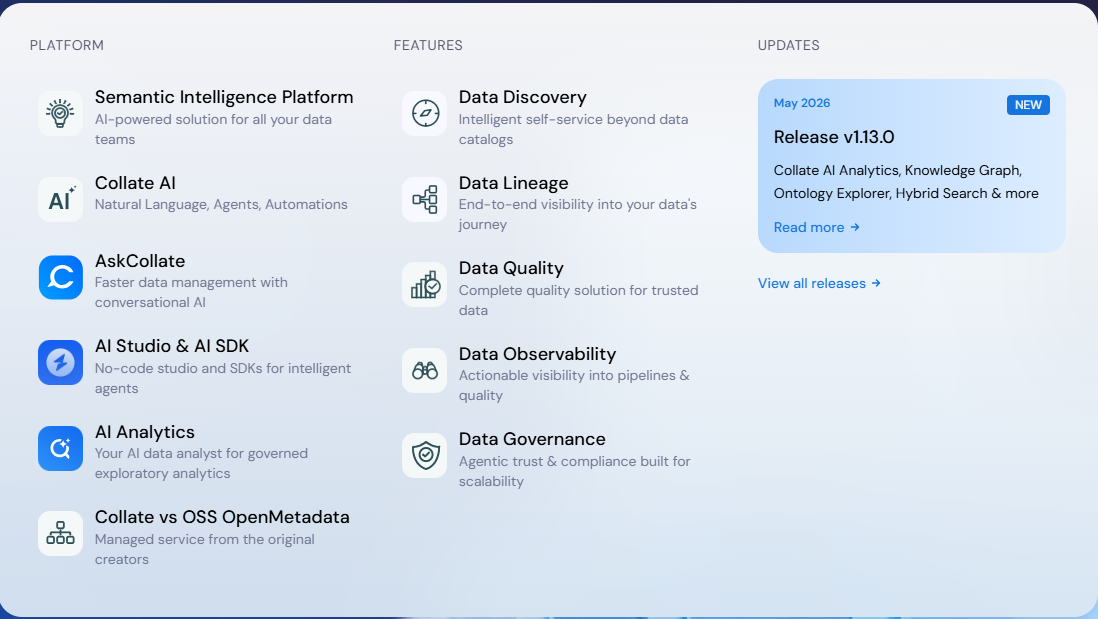
Dedicated Security & Compliance page linked prominently in navigation — security gets its own destination, signaling first-class product consideration, not afterthought
Enterprise buyers are risk-minimizers. 55% of enterprise visitors visit the Security page — validating this decision completely. When security is a navigation item rather than a badge, it communicates that the company takes it as seriously as the buyer does. Prominence is the signal.
Decision 03
Self-serve signup vs. Demo-first conversion flow
Option A
Free trial or self-serve: lower friction, higher top-of-funnel volume — but attracts non-enterprise users and adds support burden without qualifying intent
Option B — Chosen
Demo-first: every CTA drives to a demo request form that qualifies company size, use case, and timeline — friction by design, but better quality leads
Enterprise deals close through sales conversations, not self-serve trials. Demo-first funnels are a deliberate qualification mechanism — the form friction filters out non-enterprise users and lets the sales team prioritize. Demo volume doubled while lead quality improved 35%.
Website Design
The Enterprise Homepage
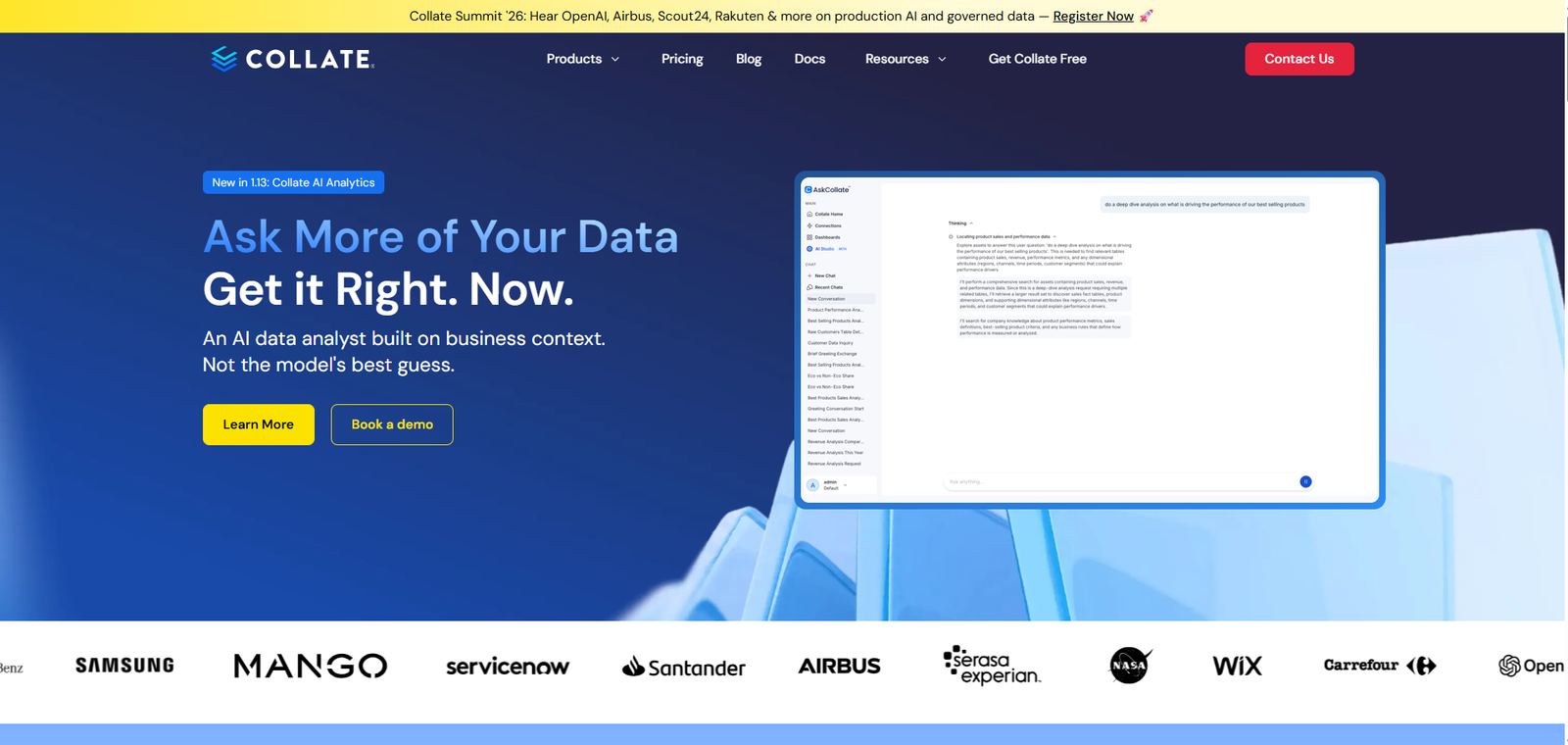
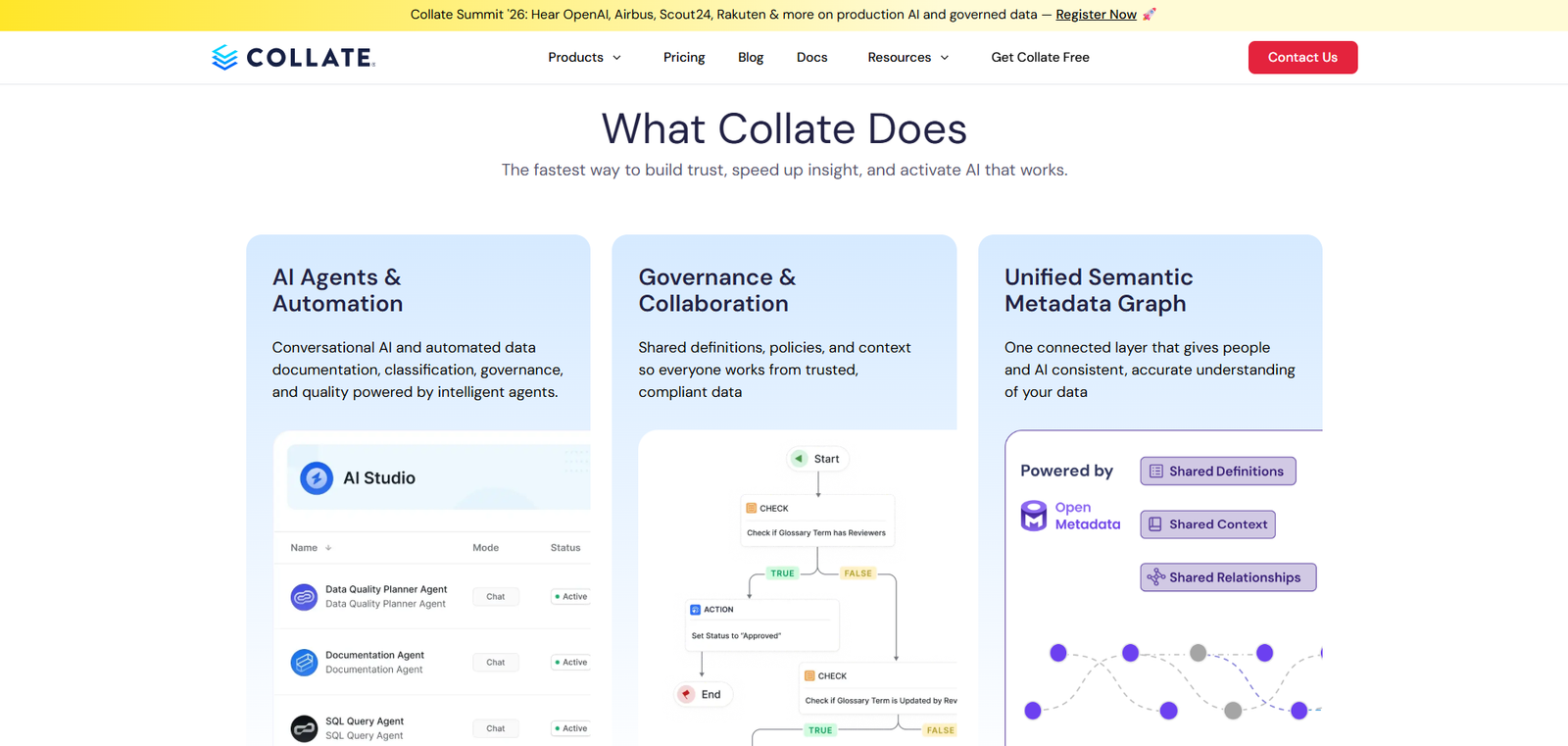
A mockup representing the getcollate.io homepage — designed to lead with AI differentiation, establish
enterprise credibility, and drive qualified demo requests from the first screen.
getcollate.io
Collate — Enterprise Website Redesign
Brand Differentiation System
Problem
Collate needed to look credibly enterprise to CDOs while retaining recognizability for developers already familiar with OpenMetadata. A shared aesthetic served neither audience well.
Approach
Deeper blue/violet palette, refined premium typography, and elevated spacing signals commercial maturity — while DNA traces back to the open-source platform for developers who know it.
User Benefit
Enterprise buyers perceive commercial credibility. Developers see a product they can trust is built on a platform they already know. Neither audience is alienated.
Business Benefit
Brand differentiation supports premium pricing. A site that looks enterprise-grade gives the sales team credibility before the first conversation happens.
AI-Forward Visual Language
Problem
"AI-powered" as a text claim was ubiquitous in 2024 — every competitor used the same phrase. The claim had become noise; buyers had become immune to it without visual evidence.
Approach
Animated AI network visualizations in the homepage hero — nodes connecting across a data mesh — visually communicate the AI intelligence layer before a word of copy is read.
User Benefit
Buyers understand the AI proposition immediately and viscerally. The animation shows rather than tells — and showing is more credible than telling.
Business Benefit
Visual differentiation in a "me-too" AI market. When every competitor claims AI and Collate demonstrates it on the homepage, Collate wins the first impression.
Trust Signal Architecture
Problem
Scattered security badges across the page suggest compliance is an afterthought. Enterprise buyers — especially in data governance — need to believe security is fundamental, not cosmetic.
Approach
Dedicated Security & Compliance page in primary navigation. Customer logos paired with outcome quotes (not just names). Trust signals given architectural priority, not decorative placement.
User Benefit
Enterprise buyers find security information where they expect it — in navigation, not buried in footer badges. 55% of enterprise visitors now visit the Security page.
Business Benefit
Security page visits correlate with higher lead quality — buyers who check compliance before requesting a demo are more serious. The architecture pre-qualifies intent.
Demo-First Conversion Flow
Problem
Enterprise deals close through conversations, not self-serve trials. A freemium path generates top-of-funnel volume but attracts non-enterprise users and adds support burden without qualifying intent.
Approach
Every CTA drives to a demo request form that qualifies company size, use case, and timeline. Friction is intentional — designed to filter casual browsers from serious enterprise buyers. Iterated 4 times based on completion rate data.
User Benefit
Enterprise buyers get a human conversation rather than a trial they have to configure themselves. The demo is the right first experience for a product of this complexity.
Business Benefit
Demo volume doubled within the first quarter. Lead quality improved 35%. The form friction is a feature, not a problem — it filters out the leads that would have wasted sales time anyway.
Measured Impact
A website that closes enterprise deals
0
More Demo Requests
Demo request volume doubled within the first quarter post-launch, with no
increase in ad spend
0
Better Lead Quality
35% increase in qualified enterprise leads (500+ employees) from the redesigned
demo form and page targeting
0
Security Page Views
55% of enterprise visitors now visit the Security page — validating its
prominent navigation placement
0
Avg. Time on Site
Enterprise visitors spend an average of 4 minutes on site, indicating genuine
engagement with product and security content
Key Learnings
What this project taught me
01
Enterprise buyers are pattern-matching on trust signals
A CDO evaluating a data governance platform is not reading every word on the page. They're scanning for: Does this look enterprise? Does security get serious treatment? Do customers I recognize use this? The architecture of those signals matters more than the copy explaining them.
02
Friction in the conversion flow is a feature, not a problem
A demo form that qualifies size, use case, and timeline filters out 80% of traffic and improves the quality of 100% of sales conversations. The instinct to reduce form friction for more leads is correct for consumer products; it's wrong for enterprise B2B. Friction is how you qualify without a human.
03
Visual proof outperforms verbal claims in AI-saturated markets
Every competitor claimed "AI-powered" in 2024. The claim had lost all differentiation. An animated network visualization on the homepage communicated the intelligence layer before any copy was processed — and visual communication is inherently more credible than claimed, because it shows rather than asserts.
04
Iterate on conversion, not just design
The demo CTA placement and messaging were iterated 4 times in the first quarter based on funnel data. The final version was not the version we launched with. Design is the starting hypothesis; data is the answer. A marketing site that ships with analytics infrastructure is a product; one that doesn't is a brochure.
"Enterprise websites have a specific job that most designers underestimate: they are the first filter in a procurement process that might take six months and involve fifteen stakeholders. Before a CDO will put Collate on the evaluation shortlist, the website needs to make them believe that this company understands their data governance problem specifically — not data problems generically. The difference between those two things is the difference between a bounce and a demo request. That precision is what the entire design brief was trying to achieve."