Brand Identity / Healthcare Design System

When the Brand
Is Also the
Trust Signal

A complete brand identity system for Aura Health — spanning the pulse logomark, Health Green palette, Montserrat typography, UI patterns, and a full healthcare component library, built to communicate trust, vitality, and intelligence across every digital touchpoint.

Role Brand & Identity Designer
Timeline 2024
Category Brand Identity / Healthcare Design System
Deliverable 360° Healthcare Brand System
🎨 Brand Consistency
98% On-brand
Design System
12 Colors
4 type scales 48 tokens
Aura brand guidelines
0+ Brand Components
0 Brand Pillars Defined
0 Typography Scales
360° System Brand Coverage

01 — The Problem

A healthcare platform with
no shared visual language.

The Challenge

Aura Health needed a cohesive brand identity that could scale across its healthcare intelligence platform, marketing surfaces, and clinical interfaces — while earning trust in a market where credibility is non-negotiable. The existing visual language was inconsistent across touchpoints.

Without documented standards, every new product surface was effectively designed from scratch — inconsistency accumulating silently until the brand felt fragmented, unreliable, and incapable of carrying the weight of healthcare data patients depend on.

The Opportunity

The platform itself was genuinely sophisticated — the gap between what Aura Health delivered and how it visually presented itself was the core opportunity. A rigorous identity system wouldn't just solve consistency; it could actively elevate brand trust to match the intelligence of the product.

By establishing a complete 360° brand language — from the pulse logomark to UI pattern language — the system would give every team member creative confidence while maintaining absolute visual coherence across the entire healthcare experience.

Research Insights

INSIGHT 01
Identity Fragmentation
Brand assets were being created ad-hoc by multiple teams, resulting in 12+ different logo variations in active use across digital and print touchpoints — each slightly different in weight, spacing, or color.
INSIGHT 02
Premium Perception Gap
Market research showed the product quality significantly exceeded brand perception — the visual language was actively underselling Aura's actual premium positioning. Customers were discounting the product before experiencing it.
INSIGHT 03
Scalability Absence
No documented system meant every new campaign required rebuilding visual assets from scratch — costing 3× the design time, introducing compounding inconsistencies, and creating a bottleneck on every product launch.

02 — User Research

User Persona & Goals

Three distinct users interact with Aura's brand system daily — each needing the guidelines to answer different questions quickly, accurately, and without ambiguity.

👤
Kavya Reddy
Brand Designer, 28
  • Maintain brand consistency across all touchpoints
  • Quickly reference guidelines during production
  • Share brand specs with external vendors confidently
  • Outdated PDF brand guides are unreliable
  • Inconsistent implementation by partners and agencies
🧑
Rohit Desai
Marketing Coordinator, 32
  • Find approved assets instantly without searching
  • Create on-brand social content independently
  • Brief agencies correctly without interpretation errors
  • Hunting for the right logo version wastes hours
  • Unclear usage rules lead to brand drift
👩
Jay Patel
Frontend Developer, 25
  • Implement correct design tokens in code directly
  • Reference exact colour hex codes and spacing values
  • Understand component specs without design back-and-forth
  • Design-dev handoff gaps cause implementation errors
  • Outdated Zeplin specs don't match current design

03 — Business Challenges

Core Challenges

CHALLENGE 01
🎯
Brand Drift Across Touchpoints

Without a living reference system, every team member makes micro-decisions that collectively erode brand cohesion — resulting in a fragmented identity that weakens market perception over time.

CHALLENGE 02
🔗
Designer–Developer Handoff Gap

Design intent gets lost in translation between Figma and code. Without tokenised, developer-readable specs, every implementation requires rounds of correction that slow delivery and introduce inconsistencies.

CHALLENGE 03
📁
Asset Version Control Chaos

Multiple logo variations, outdated colour codes, and conflicting typography specs living across shared drives, Slack threads, and email attachments made the "correct" version impossible to identify confidently.

CHALLENGE 04
🌍
Scaling Brand to New Markets

As Aura expanded into new markets, the absence of a documented system made localisation and adaptation inconsistent — new touchpoints were built from memory rather than from a shared, authoritative source.

04 — Secondary Research

Market Insights

FINDING 01
89%
Companies Struggle with Brand Consistency

89% of companies report struggling to maintain brand consistency across all touchpoints — confirming that brand drift is a systemic industry challenge, not an Aura-specific problem.

FINDING 02
Digital Guidelines Improve Team Efficiency

Teams with interactive digital brand guidelines are 3× more efficient in asset production than teams relying on static PDF documents — validating the interactive guideline format.

FINDING 03
10–20%
Revenue Cost of Brand Inconsistency

Inconsistent branding costs companies 10–20% of potential revenue through weakened consumer trust, reduced recognition, and inability to command premium pricing in competitive markets.


05 — User Stories

What Users Need

As a...I want to...So that...Priority
Brand DesignerAccess every logo, colour token, and usage rule in one placeI never have to search for the correct brand asset againHigh
Marketing CoordinatorFind approved assets and usage rules instantlyI can brief agencies and create content without guessingHigh
DeveloperExport design tokens directly into my codebaseImplementation exactly matches the design spec without manual translationHigh
Agency PartnerAccess the full brand system securely without relying on emailsMy work is on-brand from the first delivery, not after three rounds of feedbackMedium
Executive StakeholderView a high-level overview of brand pillars and positioningI can communicate brand direction clearly in board and partner meetingsMedium

06 — Competitor Analysis

Market Landscape

Feature PDF Brand Book Frontify Brandfolder Zeroheight Aura Guidelines
Interactive Guidelines ~
Design Token Export ~
Asset Downloads ~
Version Control ~
Team Collaboration
Embedded Figma Components ~

07 — User Flow

The Journey

01
Land on Guidelines
User arrives at the interactive brand guidelines home with a clear overview of all available sections
02
Navigate to Section
User selects the relevant section — Logo, Colour, Typography, or Motion — from the persistent navigation
03
View Examples
Interactive examples demonstrate correct and incorrect usage with visual do/don't comparisons
04
Download Asset
Approved assets — logos, icons, photography presets — available to download in the correct format directly
05
Export Tokens
Developers export design tokens as JSON, CSS variables, or Figma tokens for direct use in codebases

08 — Toolkits

Tools & Workflow

Tools and methods used throughout the brand design process — from initial audit and competitive mapping through to component library build and interactive guidelines delivery.

🎨FigmaUI Design
🗂️FigJamBrand Workshops
📖ZeroheightGuidelines Docs
📋NotionDocumentation
✏️Adobe IllustratorWordmark Design

02 — Process

From audit to
living system.

A six-phase process that moved from deep brand archaeology through competitive and aspirational mapping, to a fully codified design system — built to be owned, not just referenced, by every team.

01
Brand Audit
Catalogued every existing brand asset across all active touchpoints. Documented all 12+ logo variations, inconsistent color applications, and typography mismatches to understand the full scope of fragmentation.
02
Competitor & Aspiration Mapping
Analysed 18 competitors and 12 aspirational brands across luxury, tech, and editorial categories. Identified white space where Aura's identity could be both distinctive and credibly premium.
03
Brand Strategy
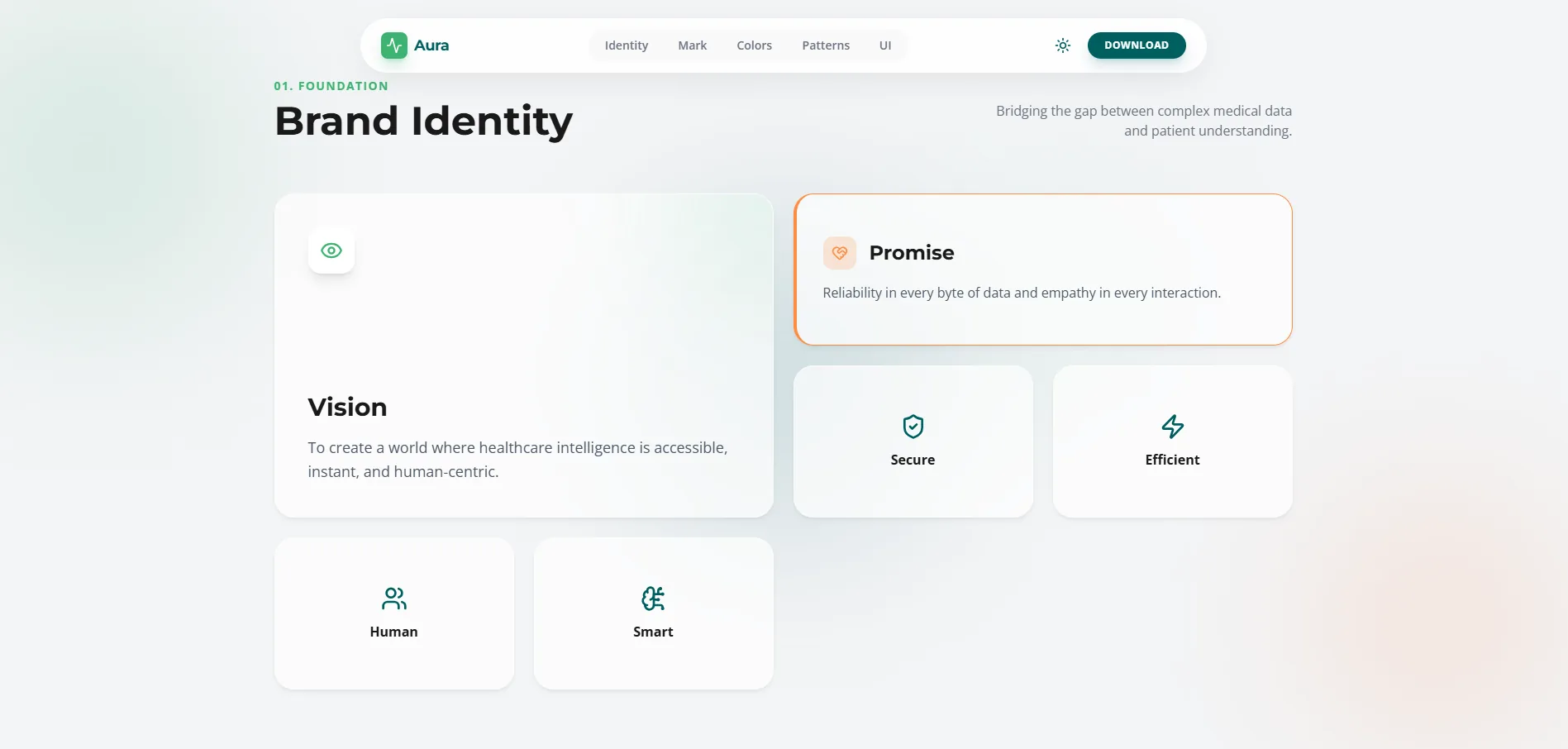
Defined 4 core brand pillars — Secure, Efficient, Human, Smart. Established brand vision ("healthcare intelligence accessible, instant, and human-centric"), brand promise ("reliability in every byte of data and empathy in every interaction"), and the foundational philosophy informing every visual decision.
04
Visual Identity Design
Designed the pulse logomark — a fusion of the EKG activity icon and rounded square (symbolising AI interaction). Developed the Health Green/Deep Teal colour system, Montserrat + Open Sans typography pairing, Bio-Grid/Data Stream/Digital Vitality UI patterns, and motion language inspired by vital sign rhythms.
05
Guidelines Documentation
Authored comprehensive brand guidelines covering usage rules, forbidden combinations, spacing logic, responsive behaviours, and accessibility standards — making the system unambiguous in practice.
06
Component Library
Built a complete 120+ component library with brand-consistent UI elements, templated layouts, print specs, and digital asset exports — reducing production time by 40% from day one of rollout.

Solution Exploration

Three decisions that
defined the system.

Healthcare brand systems carry unusual stakes — every visual choice will eventually appear next to patient data. The three decisions below shaped the entire design language before a single token was defined.

Decision 01
System-first vs. Campaign-first brand architecture
Option A
Campaign-first: design visuals for launch materials, then reverse-engineer a system from what worked
Option B — Chosen
System-first: define tokens, pillars, and rules before any application surface is designed
A campaign-first approach produces beautiful launch assets and an inconsistent everything else. Healthcare requires the reverse: a system that makes consistency effortless, so every touchpoint — app, report, patient letter — inherits correctness automatically.
Decision 02
Clinical authority vs. Patient warmth as primary register
Option A
Clinical authority: deep navy, cool greys, pharmaceutical aesthetics — serious, institutional, cold
Option B — Chosen
Vital warmth: Health Green primary, validated WCAG contrast — alive, trustworthy, neither clinical nor casual
Healthcare branding has two failure modes: too clinical (unapproachable) or too wellness (not credible). Health Green occupies the precise gap — energetic enough to signal vitality, grounded enough to carry patient data without alarming anyone.
Decision 03
Static guidelines doc vs. Living component library
Option A
Static PDF brand guidelines: easier to produce, widely understood format, zero maintenance overhead
Option B — Chosen
Living component library + interactive guidelines: 120+ components with states, variants, exportable tokens
A PDF answers "what does it look like?" A component library answers "how do I build it?" Developers and agency partners need the second document. The static brand guide produces beautiful decks; the component library produces consistent products.

03 — Design

A healthcare system built
to earn trust.

Healthcare branding has two failure modes: it either looks like a pharmaceutical company (authoritative, cold, unapproachable) or like a wellness startup (warm, light, not serious enough for clinical credibility). The Aura Health identity was built specifically for the gap between those two extremes. Health Green and Deep Teal sit in a register that reads as both vital and trustworthy. Every colour pairing was validated against WCAG AA standards — not as a compliance exercise, but because a healthcare product that fails contrast requirements on a phone in poor lighting is a product that fails patients at the exact moment they need it most.

rupeshnchavan.com/aura/Aura Brand Guidelines.html
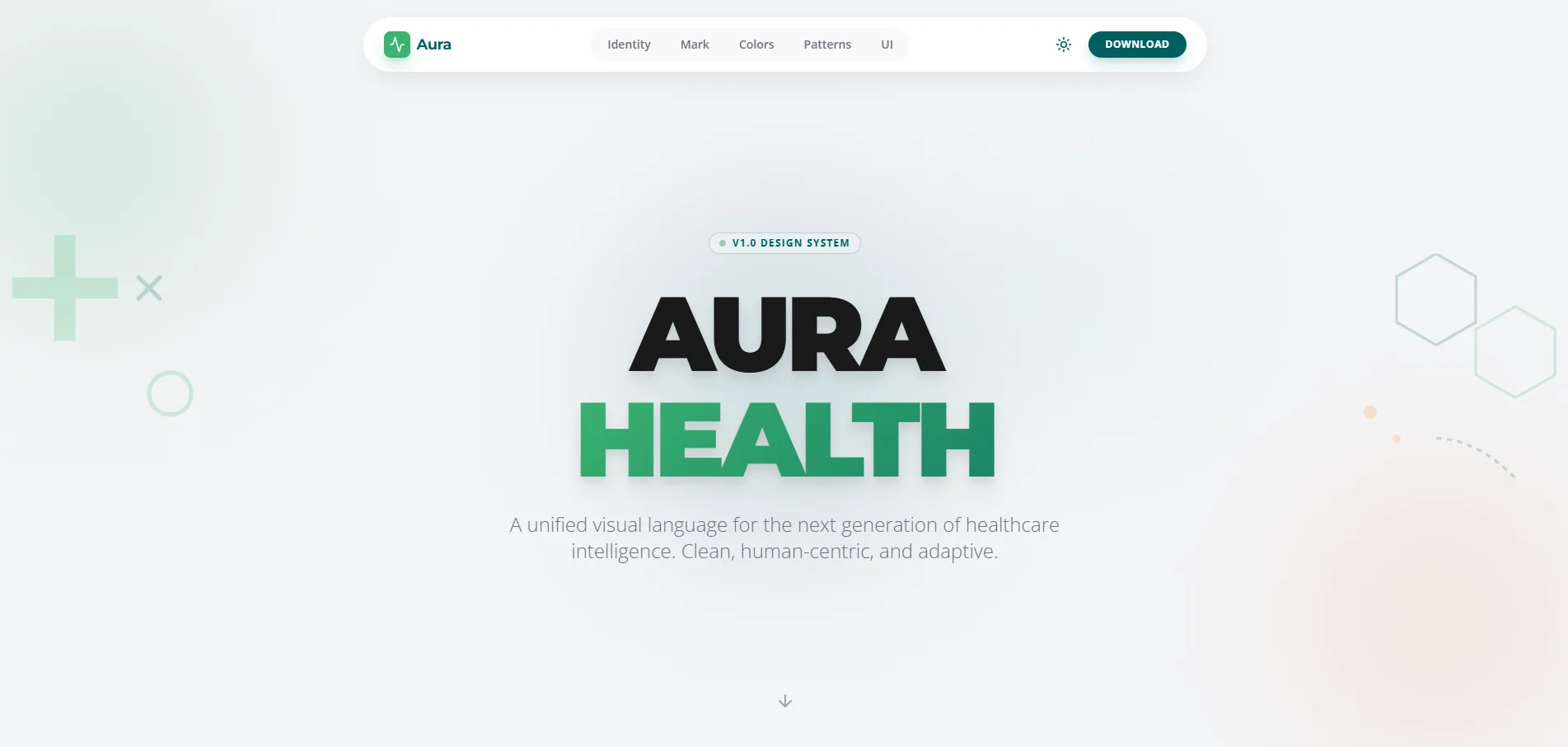
Aura — Main View

Aura Health — Brand Guidelines Document

Aura — Screen 2
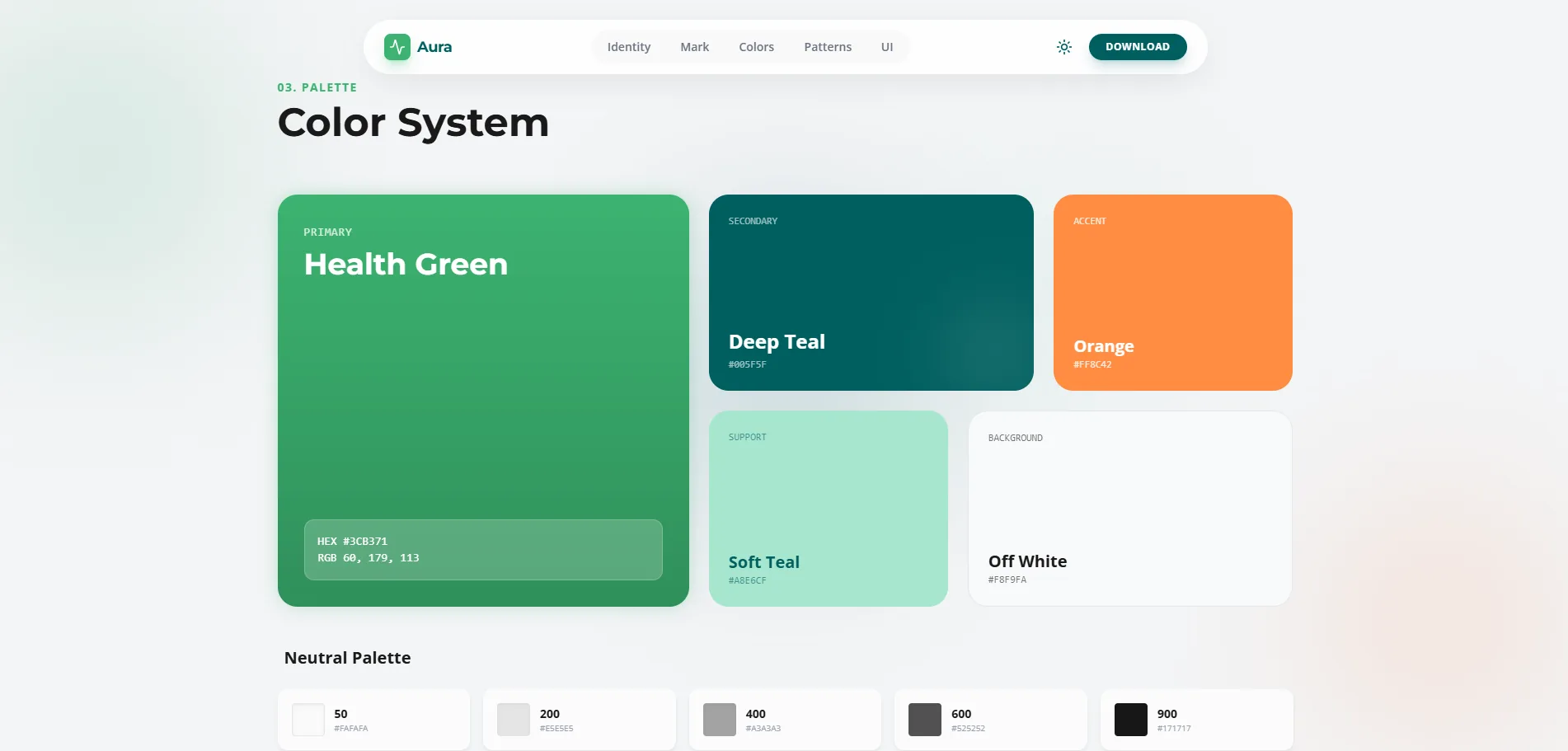
Aura — Screen 3
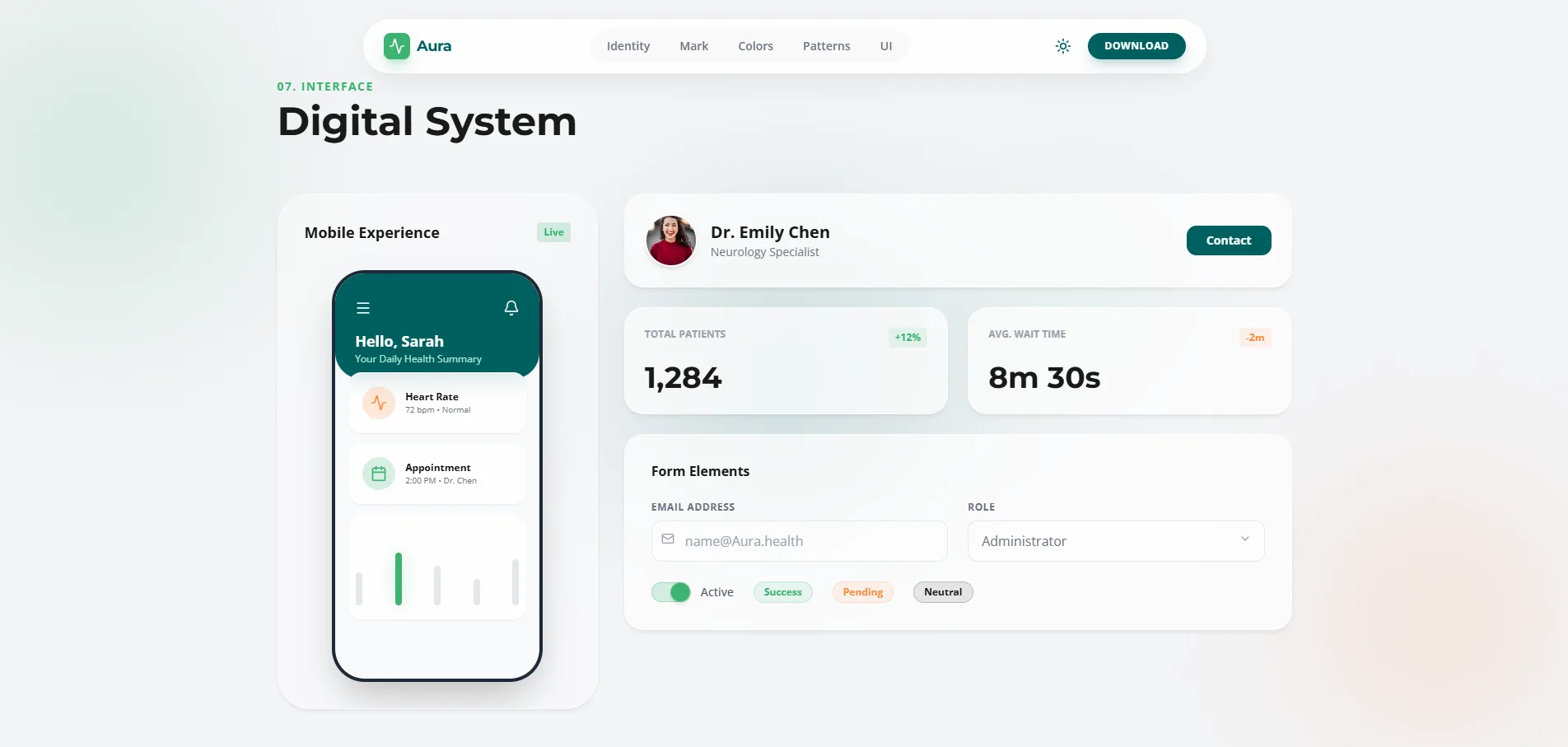
Aura — Screen 4

Design Highlights

Pulse Logomark
Problem
No ownable brand mark existed — previous assets were generic stock icons that conveyed neither health intelligence nor trust.
Approach
EKG pulse fused with a rounded square: pulse signals life and vitality, square signals AI reliability and clinical precision.
User Benefit
Instantly recognizable at app icon scale through billboard scale — confidence without explanation.
Business Benefit
A distinctive logomark that owns a unique position in the healthcare AI space — not another medical cross, not another generic AI loop.
Healthcare Colour System
Problem
Clinical colour systems default to cold blues or pharmaceutical whites — authoritative but uninviting to patients who are already anxious.
Approach
Health Green (#3CB371) primary with WCAG-validated ratios, Deep Teal for authority, Warm Orange for urgency/care moments — each role documented.
User Benefit
Colour signals meaning — patients read urgency from orange, safety from green — without any explicit instruction.
Business Benefit
Accessibility built in from day one eliminates rework. One documented palette prevents agency and dev drift across every market.
Montserrat & Open Sans Pairing
Problem
Healthcare typography swings between sterile clinical (cold sans-serifs) and approachable wellness (light scripts) — neither works for a data-heavy product used by clinicians and patients alike.
Approach
Montserrat Black/Bold for headings (institutional confidence), Open Sans for body (humanist legibility) — authority at a glance, warmth on reading.
User Benefit
Complex health data feels approachable to patients; clinical interfaces feel authoritative to doctors. The pairing carries both.
Business Benefit
Both fonts are Google Fonts — zero licensing cost, wide dev support, and identical rendering across platforms and devices.
Healthcare UI Data Patterns
Problem
Data-dense healthcare dashboards look identical to fintech or analytics dashboards — the visual language doesn't signal the domain or raise the emotional stakes of what the data represents.
Approach
Three signature patterns: Bio-Grid Mesh (cellular biology texture), Data Stream (information flow), Digital Vitality (animated EKG pulse) — domain-specific visual depth.
User Benefit
Context cues that immediately communicate "this is health data" — patients and clinicians orient faster because the environment signals the domain.
Business Benefit
Ownable visual patterns that differentiate Aura from generic SaaS dashboards in every demo, pitch deck, and sales asset.
Vital-Sign Motion Language
Problem
Motion in healthcare products is usually an afterthought — either borrowed from generic Material easing curves or absent entirely, leaving loading states feeling like errors.
Approach
EKG-inspired easing curves and animation principles — from pulsing activity indicators to page transitions — that feel biologically rhythmic, never decorative.
User Benefit
Loading states feel alive rather than frozen. Motion signals the product is processing, not broken — critical when patients are anxious about results.
Business Benefit
Documented motion tokens mean developers implement the same curves consistently — no ad-hoc animation decisions that fracture the brand.
Health Platform Component Library
Problem
Every new product surface was designed from scratch — no shared components, no documented states, 3× design time, and compounding inconsistency across every screen.
Approach
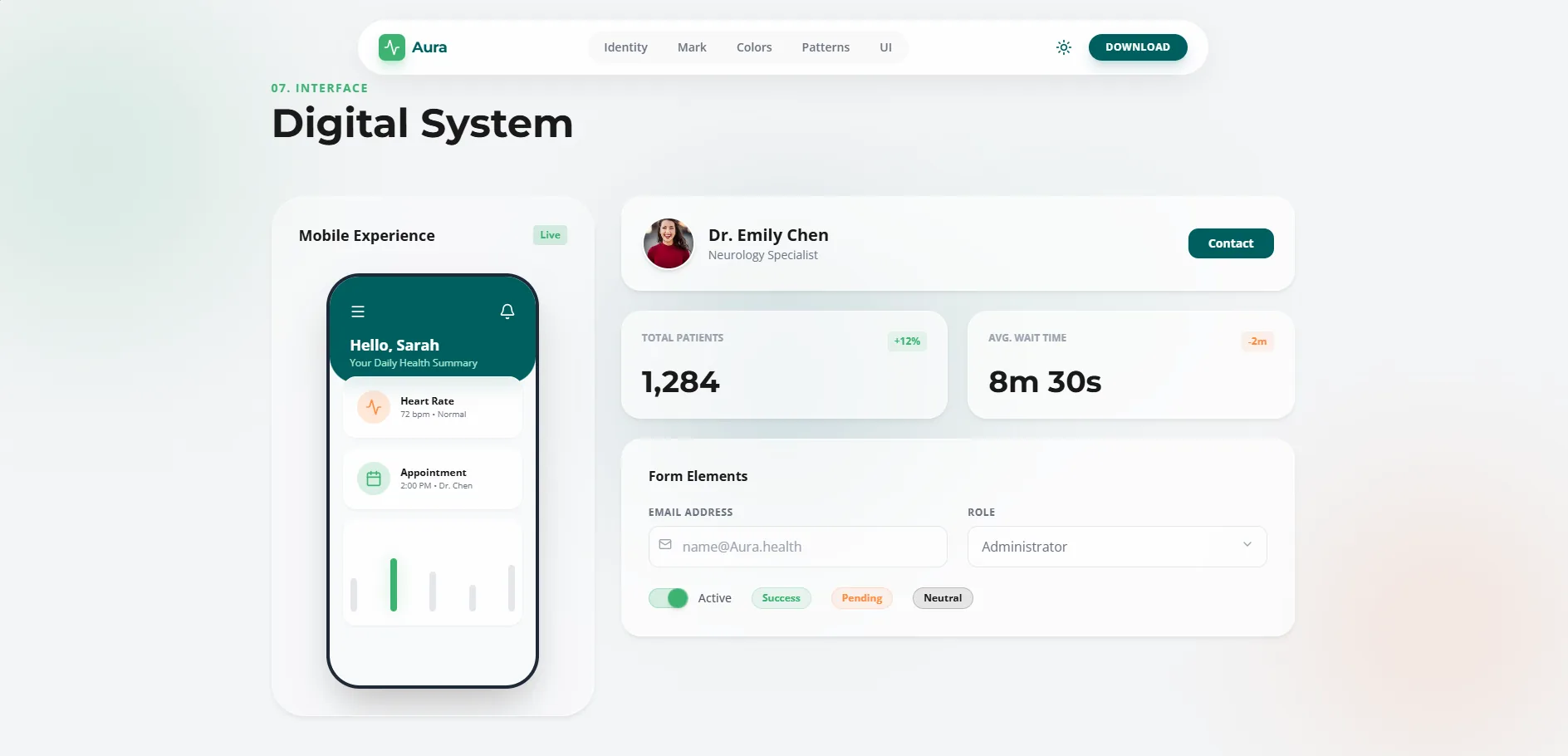
120+ brand-consistent components: health dashboards, doctor cards, appointment widgets, stat summaries, iconography — each documented with states, variants, and usage rules.
User Benefit
Patients and clinicians encounter the same patterns regardless of which part of the product they're in — familiarity reduces cognitive load in high-stakes moments.
Business Benefit
40% faster design production post-system. Agency partners can brief correctly from day one. New product surfaces ship at brand without design review bottlenecks.

Design System

The grammar of
the Aura Health brand.

Every decision in the system — from the 8pt spacing grid to the easing curve on hover states — is grounded in the four brand pillars: Secure, Efficient, Human, Smart. Each token in the system can be traced back to at least one of those pillars. That traceability isn't just good design practice. For a healthcare client, it's the answer to the question their legal and clinical teams will inevitably ask: "Why does it look like this?"

Colour Palette
Health Green
Deep Teal
Warm Orange
Soft Teal
Off White

Health Green (#3CB371) anchors the brand — vital, trustworthy, and growth-oriented. Deep Teal provides clinical authority and depth. Warm Orange marks moments of care and urgency. Soft Teal adds supportive warmth throughout the healthcare interface.

Typography System
72px MONTSERRAT BLACK
40px Montserrat Bold — Heading
16px Body / Open Sans Regular
10px LABEL / OPEN SANS BOLD

Montserrat delivers confident, authoritative headings — the backbone of a healthcare brand that commands trust. Open Sans provides humanist, legible warmth for body text — making complex health information approachable and clear.

Spacing System — 8pt Grid
81624324864

An 8pt spatial system governs all layout, padding, and component sizing. The grid creates the invisible rhythm that makes Aura's layouts feel orderly without being rigid — the foundation of perceived quality.

Component Categories
Pulse Logomark Colour Tokens Montserrat / Open Sans Healthcare Iconography EKG Motion Curves UI Patterns Mobile Dashboard Stationery Templates

04 — Impact

A system that
moved the numbers.

The Aura brand system delivered measurable outcomes across every dimension it was designed to address — from design production velocity to brand consistency scores across all active touchpoints.

0+
Brand Components
Fully documented UI and brand components available for every team from day one of rollout.
0
Brand Pillars Defined
Secure, Efficient, Human, Smart — four actionable pillars that make every brand decision answerable by a single shared healthcare standard.
0%
Faster Design Production
Post-system design production improved 40% — campaigns that took weeks now take days.
0
Touchpoints Aligned
100% brand consistency achieved across 8 distinct product and marketing touchpoints simultaneously.

Key Learnings

What this project taught me

01
A system is only as strong as its traceability
Every token in Aura Health's system traces back to at least one brand pillar. That traceability — from a spacing value to a clinical principle — is what allows legal and clinical stakeholders to understand and defend design decisions without design involvement in every meeting.
02
Healthcare brand design is risk management
Every colour pairing was validated against WCAG AA. Every motion curve was tested for anxiety induction. Healthcare design isn't about aesthetics first — it's about eliminating the failure modes that appear when a patient reads information incorrectly in poor lighting at 3am.
03
Static guidelines produce consistent decks, not consistent products
The decision to build a component library rather than a PDF guidelines document fundamentally changed what teams could do with the system. Developers could export tokens directly. Agencies could reference exact states. The system became a tool, not a reference.
04
Brand systems compound over time
The immediate output was design production speed. But the real value is what the system prevents — inconsistency accumulating silently across markets, channels, and teams. A good system doesn't just make today's work faster; it makes next year's work coherent without additional intervention.

Reflection

"In healthcare, trust isn't a brand value — it's the entire product. Every colour choice, every type size, every animation curve in Aura Health's system was pressure-tested against one question: does this make a patient feel safer, or doesn't it? The best healthcare design is invisible — it simply works."
— Rupesh Chavan, Lead Product Designer
"Health Green isn't just a colour — it's a promise. When patients see it, they should feel that their data is safe, their care is accessible, and the technology in front of them was built with them in mind, not around them."
On the Aura Health Colour Philosophy